
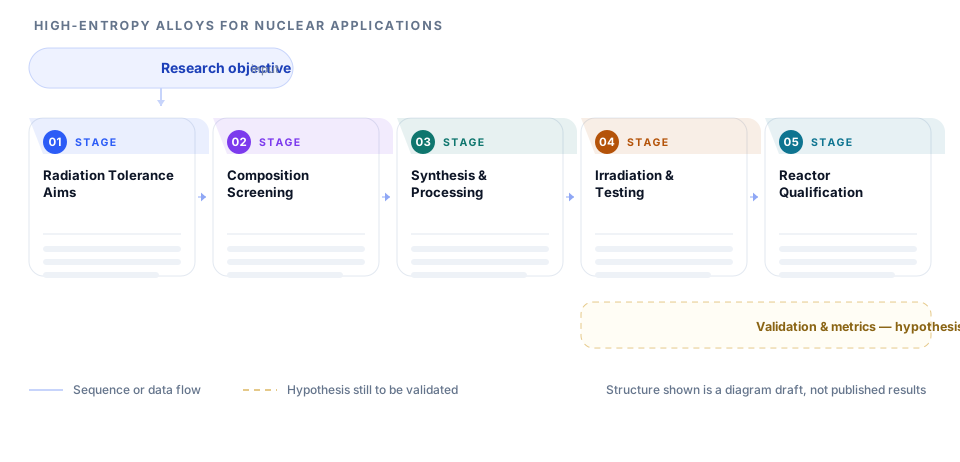
This page illustrates intended research design. It is not evidence that any result has been achieved.
A roadmap for alloy development aimed at radiation tolerance in reactor environments. It separates the tolerance question, the composition space, the synthesis route, the irradiation and characterization plan, and the qualification pathway.
Layer structure
How to read this roadmap
- Begin with the damage mechanism and service conditions, because they decide which compositions are worth considering at all.
- Read the screening layer to see how a vast composition space is reduced and on what explicit criteria.
- Move to synthesis, where the processing route and heat treatment determine whether the intended phase actually forms.
- Follow into irradiation and testing, checking the dose, temperature, and reference alloy chosen for comparison.
- End at qualification, which shows what would be required before a material enters a reactor.
Design logic behind the structure
Mechanism before alloy
The damage mechanism is named first so composition screening is judged against a specific failure mode rather than general toughness.
Screening is a layer
Narrowing a multi-element space is treated as its own research stage, with explicit criteria for what survives the cut.
Processing determines phase
Synthesis and heat treatment are drawn separately from composition because the same alloy can form different phases depending on route.
Comparison alloy fixed
A reference material is declared in the testing layer so irradiation results have a baseline and the central claim is falsifiable.
Adapting this structure to your own project
When this structure fits - and when it does not
A good fit when
- Alloy development projects targeting reactor or fusion environments.
- Studies that combine computational screening with irradiation experiments.
- Proposals that must show a path from laboratory coupons to qualified material.
Not a fit when
- Ambient-temperature structural alloy work with no irradiation component.
- Pure thermodynamic modeling with no synthesis or testing plan.
- Corrosion studies conducted in non-nuclear environments.
Frequently asked questions
Does the roadmap claim radiation tolerance is achieved?
No. It lays out how a study would test whether a composition resists a specific damage mechanism under defined conditions. Tolerance is the hypothesis the experiments are designed to examine.
Why screen compositions before synthesizing?
The composition space for multi-principal-element alloys is enormous. A screening layer makes selection criteria explicit and keeps experimental effort focused on a defensible shortlist.
How is processing separated from composition?
Because phase stability and grain structure depend heavily on the synthesis route and heat treatment. Separate layers prevent a processing effect from being reported as a compositional one.
Are neutron sources required?
Ion irradiation can screen behavior faster and with controlled dose, but qualification generally requires neutron data. The roadmap lets you show both stages rather than assuming one replaces the other.
Sources and further reading
- STROBE - reporting guidance for observational studiesSTROBE Initiative
- ARRIVE - reporting guidance for animal researchARRIVE Guidelines
- CONSORT - reporting guidance for randomised trialsCONSORT Group
- ORCID - persistent identifiers for researchersORCID
These are the organisations whose published guidance the recommendations on this page follow. Listing them does not imply that they endorse Pathform AI, and this page is not affiliated with them.