
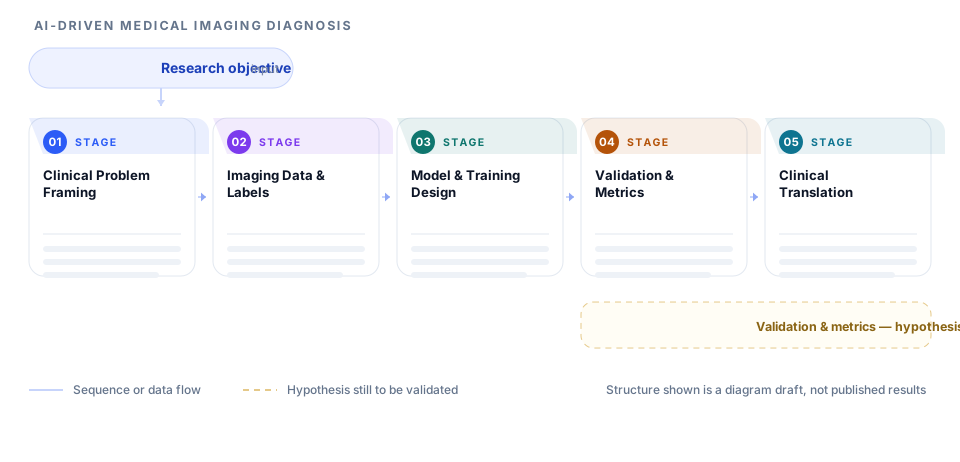
This page illustrates intended research design. It is not evidence that any result has been achieved.
A roadmap for studies that train and evaluate deep learning models on clinical imaging. It separates the clinical question, the imaging data, the model design, the validation protocol, and the translation path so reviewers can judge each part on its own.
Layer structure
How to read this roadmap
Start at the top with the clinical question, because everything below it is only justified if it changes a real diagnostic decision.
Move to the imaging data layer to check whether the cohort, scanners, and reference standard can actually support that question.
Read the model layer as a set of design commitments rather than a performance claim, noting which choices are fixed and which will be tuned.
Follow into validation, where the diagram should show the split structure and the endpoints chosen before training started.
Finish at translation, which shows the studies and approvals still needed after the model performs well in a retrospective setting.
Design logic behind the structure
Question before model
The clinical decision is fixed first so architecture choices are judged against a diagnostic need rather than against benchmark scores.
Data governance explicit
Inclusion criteria, annotation rules, and reference standards are drawn as separate boxes because they bound what any result can mean.
Pre-specified evaluation
Split structure and endpoints appear before the training layer so a reader can see there was no metric shopping after the fact.
Translation as a stage
Deployment and regulatory evidence are treated as research stages rather than an afterthought, which is what clinical reviewers usually probe.
Adapting this structure to your own project
- Replace the diagnostic decision with your own task and keep the five-layer spine unchanged.
- Move your annotation protocol into the data layer and make the reference standard explicit for every label.
- List the pretraining corpus and augmentation policy under the model layer so reviewers can judge transfer risk.
- Add a calibration and subgroup box to the validation layer if your patient population is clinically heterogeneous.
- Use the translation layer as a checklist when writing the impact section of a grant proposal.
When this structure fits - and when it does not
A good fit when
- Diagnostic or screening studies that combine a clinical cohort with a learned model.
- Radiology, pathology, and cardiology projects where the reference standard needs defending.
- Grant aims that require a clear separation between data work, modeling, and evaluation.
Not a fit when
- Pure methods papers with no clinical cohort and no deployment question.
- Exploratory work where the imaging task itself is still being defined.
- Studies that report only internal cross-validation and have no plan for external testing.
Frequently asked questions
Does the diagram claim the model works?
No. It shows the intended research design: question, data, model plan, validation protocol, and translation path. Performance is what the study is built to test, not something the diagram asserts.
How much detail belongs in the imaging data layer?
Enough that a reviewer can see where images come from, who was included, how labels were produced, and what counted as ground truth. Scanner and site variation deserve their own box.
Can I use this structure for a methods-focused paper?
Yes, but trim the translation layer. Methods work is better served by expanding the model and validation layers and stating clearly which claims the experiments cannot support.
Is patient privacy handled by the tool?
The diagram is built from the text you upload and does not query or store patient records. De-identification, ethics approval, and data-use agreements remain the research team's responsibility.
Sources and further reading
- EQUATOR Network - library of reporting guidelinesUK EQUATOR Centre, University of Oxford
- STROBE - reporting guidance for observational studiesSTROBE Initiative
- ARRIVE - reporting guidance for animal researchARRIVE Guidelines
- CONSORT - reporting guidance for randomised trialsCONSORT Group
These are the organisations whose published guidance the recommendations on this page follow. Listing them does not imply that they endorse Pathform AI, and this page is not affiliated with them.