
A design for studies asking why individuals respond differently to the same fiber intervention. The roadmap separates the dietary question, the cohort and sampling plan, the metagenomic and metabolite measurements, the response model, and the translation into dietary guidance.
Layer structure
How to read this roadmap
Begin with the response question, because a vague definition of improvement makes every later measurement ambiguous.
Read the sampling layer next to confirm that timing, dietary control, and storage can support the metabolic claims being made.
Move into profiling and check that sequencing and metabolite assays answer the same functional question.
Follow into modeling, where baseline covariates and confounder adjustment define what the output can responsibly predict.
End at translation, which shows how a model becomes advice and what evidence would be required before recommendations are offered.
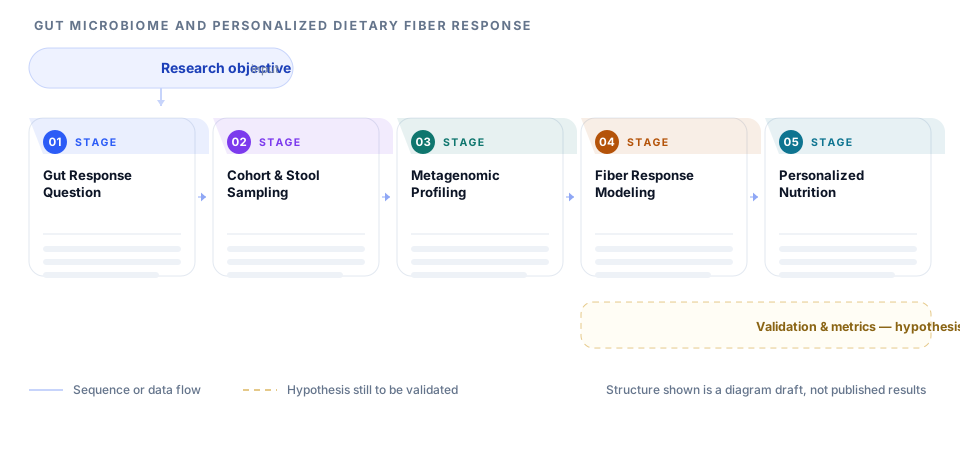
This page illustrates intended research design. It is not evidence that any result has been achieved.
Design logic behind the structure
Responder defined first
Naming the responder threshold before collection prevents the definition from being tuned to whatever the analysis eventually produces.
Sampling drives inference
Sampling frequency and dietary control are drawn as design choices because they cap the temporal claims the study can make.
Function over taxonomy
Metagenomic and metabolite layers sit side by side so taxonomic shifts are interpreted only alongside a functional readout.
Confounders are structural
Diet, antibiotics, and medication appear inside the model layer rather than in a limitations paragraph at the end.
Adapting this structure to your own project
- Swap the fiber intervention for your own dietary or supplement exposure and keep the responder logic.
- Add a washout or crossover arm to the sampling layer if your design needs within-person comparison.
- List the metabolite panel beside the sequencing box so reviewers see the intended functional link.
- Pre-specify your confounder set in the modeling layer and state how each variable is measured.
- Use the translation layer to separate exploratory stratification from anything you would actually recommend.
When this structure fits - and when it does not
A good fit when
- Human intervention studies with pre- and post-intervention sampling.
- Cohort studies linking diet, microbiome composition, and host markers over time.
- Proposals that need a defensible responder definition and a pre-stated analysis plan.
Not a fit when
- In vitro fermentation work with no human sampling frame.
- Descriptive surveys that do not measure a response to any intervention.
- Studies where the primary outcome is still undecided when the proposal is written.
Frequently asked questions
Does this roadmap assume the intervention works?
No. It describes how a study would be organized to test whether response differs between people. The diagram shows the intended design; outcomes depend on data that has not been collected yet.
Why separate sampling from sequencing?
Because sample timing, dietary control, and storage constrain interpretation independently of sequencing quality. Reviewers often probe those decisions separately in methods review.
Can the framework handle diet as a confounder?
Yes. The modeling layer is where you declare how diet, medication, and antibiotic exposure are measured and adjusted for, or why they are treated as effect modifiers instead.
Is the tool making biological claims?
It organizes the structure you describe. Interpretation of microbial and metabolic findings stays entirely with the research team and the data they collect.
Sources and further reading
- STROBE - reporting guidance for observational studiesSTROBE Initiative
- ARRIVE - reporting guidance for animal researchARRIVE Guidelines
- CONSORT - reporting guidance for randomised trialsCONSORT Group
- ORCID - persistent identifiers for researchersORCID
These are the organisations whose published guidance the recommendations on this page follow. Listing them does not imply that they endorse Pathform AI, and this page is not affiliated with them.