
A roadmap for research that uses tensor network methods to model superconducting qubit systems. It separates the noise problem, the device data, the simulation methods, the benchmark metrics, and the path toward larger circuits.
Layer structure
How to read this roadmap
Begin with the noise process you intend to model, since the required accuracy follows from the physical question rather than from convenience.
Read the device layer to see which measured parameters ground the simulation and how calibration drift is handled.
Move into the tensor network layer, where ansatz and bond dimension choices set the reachable regimes.
Check the benchmark layer for comparison against measured observables and an honest statement of truncation limits.
End with scaling, which shows what the method would be used for once it has been validated on small systems.
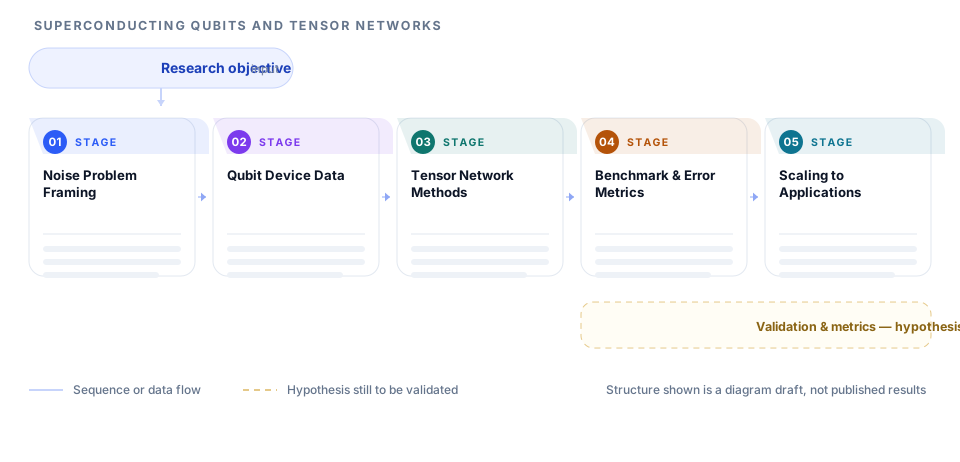
This page illustrates intended research design. It is not evidence that any result has been achieved.
Design logic behind the structure
Accuracy follows purpose
The required precision is derived from the physical question rather than chosen for convenience, which keeps the method honest about its limits.
Device data grounds theory
Measured relaxation, dephasing, and coupling values appear explicitly so the simulation connects to a real device rather than an idealized model.
Bond dimension as boundary
The tensor network layer names its own limits, because entanglement growth decides where the approximation stops being trustworthy.
Benchmark before scaling
Scaling sits after validation, so extrapolation to larger circuits is only proposed once small-system agreement has been demonstrated.
Adapting this structure to your own project
- Replace the noise channel with the mechanism your device suffers from and keep the validation spine.
- Put measured device parameters in the data layer with a note on how often they are recalibrated.
- State your bond dimension and truncation tolerance explicitly so readers can judge the error budget.
- Add cross-validation against an exact method for the smallest system you can simulate.
- Use the scaling layer to name the circuit sizes you expect to be tractable and the ones you do not.
When this structure fits - and when it does not
A good fit when
- Simulation work aimed at characterizing noise in superconducting hardware.
- Methods proposals that need an explicit error budget and validation plan.
- Projects connecting device calibration data to algorithm-level predictions.
Not a fit when
- Hardware fabrication studies with no simulation component.
- Pure algorithm work that assumes ideal qubits throughout.
- Benchmarks that report no comparison against measured device data.
Related reading
- Technical Roadmap Pack
- Research Architecture Pack
Frequently asked questions
Does the roadmap assert that tensor networks can simulate large circuits?
No. It structures a study that would test where the method remains accurate and where truncation error takes over. That boundary is what the research is designed to find.
Why start from device data rather than theory?
Because relaxation and dephasing rates from the actual hardware constrain which noise models are plausible. Starting from measurements keeps the simulation tied to real device limits.
How is accuracy judged?
By comparing simulated observables with measured ones on systems small enough for exact treatment, and by reporting the bond dimension at which results stop changing.
Is this only for superconducting platforms?
The five layers transfer to trapped ions or neutral atoms, but the device data layer changes substantially, so the parameter set and noise channels need rebuilding.
Sources and further reading
- EQUATOR Network - library of reporting guidelinesUK EQUATOR Centre, University of Oxford
- STROBE - reporting guidance for observational studiesSTROBE Initiative
- ARRIVE - reporting guidance for animal researchARRIVE Guidelines
- CONSORT - reporting guidance for randomised trialsCONSORT Group
These are the organisations whose published guidance the recommendations on this page follow. Listing them does not imply that they endorse Pathform AI, and this page is not affiliated with them.