
A structure for battery research that runs from a performance target to an integrated pack. It separates the requirements, the chemistry and cell data, the electrode and cell design, the cycling and safety metrics, and the system-level integration.
Layer structure
How to read this roadmap
Start with the requirement set as a whole, because a target written for energy alone will conflict with power and lifetime.
Read the chemistry layer to see which baseline properties are measured rather than assumed.
Move into cell design, where loading and porosity choices determine whether the stated targets are reachable at all.
Follow the cycling and safety layer to check that test conditions match the intended application.
Finish at integration, which shows what the pack imposes back on the cells.
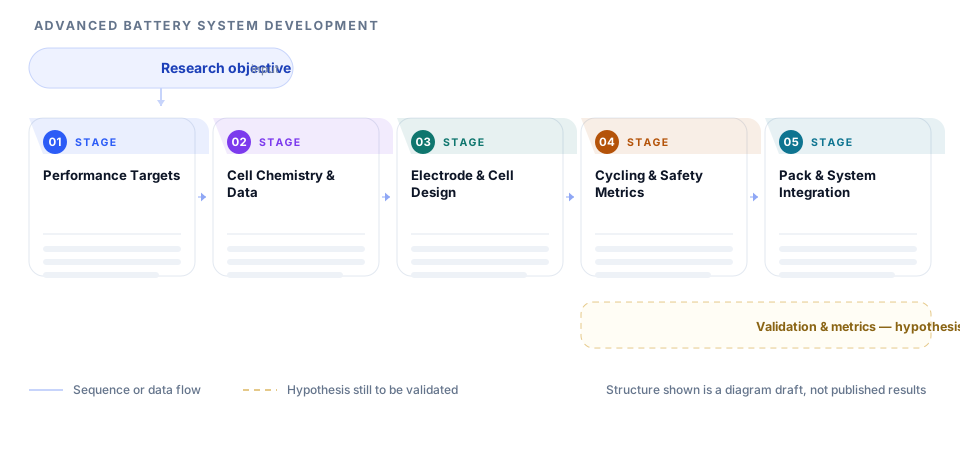
This page illustrates intended research design. It is not evidence that any result has been achieved.
Design logic behind the structure
Requirements written together
Energy, power, lifetime, and cost appear as one layer so trade-offs are visible instead of being discovered late in testing.
Baseline before design
Measured material properties are recorded before electrode design so improvements can be attributed rather than asserted.
Test matrix pre-specified
Cycling conditions and abuse tests are defined in advance, which is what separates a controlled comparison from a demonstration.
Integration constrains cells
Pack-level thermal and mechanical limits are drawn as design constraints rather than downstream engineering problems.
Adapting this structure to your own project
When this structure fits - and when it does not
A good fit when
- Cell and electrode research with a defined application in mind.
- Proposals that must connect material improvements to pack-level requirements.
- Safety-focused studies that need a structured abuse test plan.
Not a fit when
- Fundamental electrolyte spectroscopy with no cell-level goal.
- Market or supply chain analyses with no experimental component.
- Single-material studies that never reach full-cell testing.
Frequently asked questions
Does the roadmap show that the battery meets its targets?
No. It structures the study so targets, design choices, and the test protocol are visible together. Whether the cells meet the numbers is what the experiments are designed to establish.
Why list requirements as one layer?
Because energy, power, lifetime, and cost trade against each other. Drawing them together makes the compromises explicit at the design stage instead of after the first cycling results.
How detailed should the test matrix be?
Detailed enough that another group could repeat it: temperature, C-rate, depth of discharge, and the retention threshold that counts as failure. Vague protocols make results hard to compare.
Does the framework apply to solid-state cells?
Yes, though the cell design layer gains an interface box for stack pressure and interfacial contact, which dominate solid-state performance.
Sources and further reading
- ORCID - persistent identifiers for researchersORCID
- JATS - Journal Article Tag Suite, the standard article structureNational Center for Biotechnology Information, U.S. National Library of Medicine
- EQUATOR Network - library of reporting guidelinesUK EQUATOR Centre, University of Oxford
- STROBE - reporting guidance for observational studiesSTROBE Initiative
These are the organisations whose published guidance the recommendations on this page follow. Listing them does not imply that they endorse Pathform AI, and this page is not affiliated with them.