
A roadmap for studies that remove recalcitrant contaminants using advanced oxidation. It separates the contaminant problem, the water matrix, the radical generation process, the degradation and byproduct metrics, and the path to pilot and regulatory acceptance.
Layer structure
- 01Contaminant Framing
Names the target compounds, their expected concentrations, and the regulatory limit the treatment process is intended to meet.
- 02Water Matrix Data
Characterizes the background water, since alkalinity, natural organic matter, and radical scavengers control oxidant demand.
- 03Radical Process Design
Defines the oxidant, activation method, dose basis, and reactor configuration that together generate the reactive species.
- 04Degradation & Byproducts
Specifies removal kinetics, mineralization extent, and transformation product or toxicity assays used to check for harmful intermediates.
- 05Pilot & Regulatory Fit
Covers scale-up, energy demand, and the monitoring a utility would need before adopting the process in a treatment train.
How to read this roadmap
Begin with the target contaminants and the regulatory limit, because removal without a benchmark is difficult to interpret.
Read the water matrix layer to see which background constituents will consume oxidant before the target compound does.
Move to process design, where oxidant choice and activation method determine the radical yield you can expect.
Follow the degradation layer to check that byproducts and mineralization are measured, not only parent compound removal.
Finish at pilot and regulatory fit, which shows what a utility would need before adopting the process.
Design logic behind the structure
Regulatory target stated
The treatment goal is tied to a limit rather than a percentage, which keeps the eventual performance claim meaningful and comparable.
Matrix governs demand
Background water chemistry is drawn as a governing layer because scavengers often consume more oxidant than the contaminant itself.
Byproducts are mandatory
Transformation products and toxicity checks sit inside the design, since partial oxidation can produce compounds of greater concern.
Scale-up in scope
Pilot performance and energy demand appear as a research stage, which is what distinguishes a treatment study from a chemistry demonstration.
Adapting this structure to your own project
- Replace the target compound with your own contaminant and state the limit you are aiming at.
- Report background water characteristics before presenting any dose-response results.
- State your oxidant dose basis clearly so results can be compared across studies.
- Add a toxicity or bioassay box in the byproduct layer for any partial oxidation process.
- Use the pilot layer to estimate energy demand per order of magnitude removed.
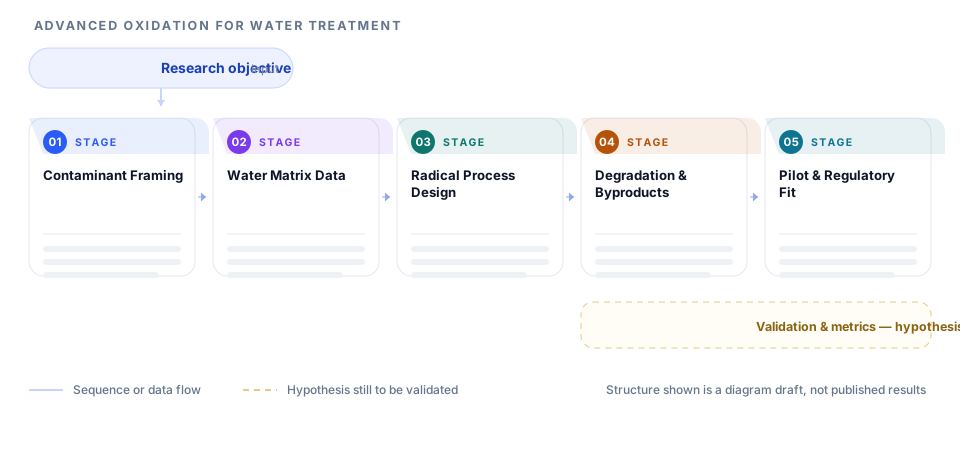
This page illustrates intended research design. It is not evidence that any result has been achieved.
When this structure fits - and when it does not
A good fit when
- Treatment studies targeting trace organic contaminants in real water matrices.
- Proposals that must address transformation products and toxicity.
- Work intended to move from bench reactors toward pilot scale.
Not a fit when
- Ideal-solution kinetics with no real water matrix component.
- Membrane or adsorption studies that contain no oxidation step.
- Descriptive monitoring programs with no treatment process.
Related reading
- Technical Roadmap Pack
- Research Architecture Pack
Frequently asked questions
Does the roadmap claim the contaminants are removed?
No. It shows how a treatment study would be organized to measure removal and check for harmful byproducts. Removal efficiency is the outcome the experiments are designed to determine.
Why is the water matrix its own layer?
Because scavengers such as carbonate and natural organic matter consume oxidant, so performance in ultrapure water rarely transfers to a real source. Separating the matrix makes that gap visible.
Are byproducts always a concern?
For advanced oxidation, yes. Incomplete oxidation can generate intermediates whose toxicity differs from the parent compound, so transformation products and bioassays belong in the design.
What belongs in the pilot layer?
Reactor scale, hydraulic retention time, oxidant consumption per volume treated, and the monitoring parameters a utility would require. It connects bench results to an actual treatment train.
Sources and further reading
- ORCID - persistent identifiers for researchersORCID
- JATS - Journal Article Tag Suite, the standard article structureNational Center for Biotechnology Information, U.S. National Library of Medicine
- EQUATOR Network - library of reporting guidelinesUK EQUATOR Centre, University of Oxford
- STROBE - reporting guidance for observational studiesSTROBE Initiative
These are the organisations whose published guidance the recommendations on this page follow. Listing them does not imply that they endorse Pathform AI, and this page is not affiliated with them.